Good Stewardship

On an evening woods walk with Pipp, I contemplated what good stewardship means to me and what it looks like in my life. I thought back to the NH Natural Resources Stewardship Program offered through the UNH Cooperative Extension and its emphasis on resource management and conservation rather than preservation exclusively.

Winter Woods Walk

So many people think of themselves and nature as two separate entities. They view humans as a blemish on the Earth—sometimes understandably, given the situation we are in regarding climate change. However, it’s as if we expect ourselves not to have any impact or make any alterations to our home planet. The reality is that every living thing shapes its environment. As humans, we have both the blessing and the curse of being able to choose how we do so. I would like to make this impact as beneficial as possible and strive to care for and manage resources in a way that keeps them healthy and abundant for the future.

For a long time, I thought of good stewardship and conservation solely in relation to wilderness, landscapes, and wildlife. Along the way, I’ve become involved in many clubs and organizations that put this focus front and center. All of them are volunteer-run, with small budgets and a heavy reliance on fundraising. Their challenges range from attracting young people and new demographics to engaging members and encouraging volunteer involvement. It struck me that our duty as good stewards also extends to these clubs. If we cannot care for these valuable organizations that do so much good work in regard to hunting, angling, trapping, and public land use, where would we be as sportsfolk?

I think many of us are resistant to volunteering because we feel underqualified, undertrained, or underinformed. Most people live very busy modern lives and don’t feel they have the time or bandwidth. The irony is that, speaking from experience as an adult-onset hunter and shooter, almost all of my present-day knowledge and experience came from jumping in headfirst and getting involved with volunteer organizations—from BHA and RGS/AWS to BICA and my local gun range. I learned about grouse and woodcock and their habitats. I learned about good dog work and handling. I later developed an interest in trapping, and joined the NH Trappers’ Association. While I’ve been too busy training Pipp to take it up myself, it’s opened a world of appreciation for trappers and all that they do to gather data on so much of our wildlife here in New England.

I was a vegetarian for four years. In college, I studied the major issues with industrial farming. I support ethical and humane practices for raising animals for food and buy local meat or hunt my own. If you’re a human on this planet and you eat, which is required for survival, then you consume life for your own needs. Even if you don’t eat meat, our food systems have casualties along the way such as ground nesting birds, rodents, snakes, insects and plants life. Good stewardship is how we stay responsible and accountable for our use of esources.

Snowy Adventures

One of my favorite authors is George Bird Evans. There’s a segment in his book “An Affair with Grouse” that describes what it means to love these birds and how someone who loves them can still hunt them. It’s eloquently put and far more articulate than my own words.

“How then can you love a bird and kill it and still feel decent? I think the answer is, to be worthy of your game.”

I agree with this sentiment wholeheartedly, and furthermore believe the modern grouse hunter and bird dog enthusiast has even more work to do to be worthy of their game. What I mean by this is that there are those who would like to see us lose these traditions—training dogs, hunting birds, and keeping these gundog breeds working. I’ve always felt the only logical response is to get involved in conservation groups to ensure these birds are around for a long, long time—not just for our purposes, but for the birds themselves and their right to exist, for the preservation of gundog breeds, and for practices such as trapping and shooting sports.

There are times when I feel my efforts are just a drop in the bucket. This winter, the temperature dropped near 0°F several times, and I needed to keep the kitchen sink dripping. Not wanting to waste the water, I put a container underneath to save it for the dog’s water bowls. I was shocked in the morning to find that what I thought was a large container had completely overflowed.

The reality is that I am just one drop in the bucket. To you, dear reader, please know that each of you is another drop. We don’t get a full bucket with one drop—or even several drops. It takes a village, as they say.

The birds. The dog breeds. The wild places. The clubs and organizations. Let’s work together to leave all of these things better than we found them—and in turn, our involvement will certainly better us for it. That is the meaning of good stewardship.
Full Circle

This week, I stood in a firehouse classroom in Croydon, New Hampshire, volunteering as a Hunter Education instructor for the very first time. I wasn’t leading the lessons yet—mostly observing—but it felt like an important step. Outside the firehouse, within walking distance, was Spectacle Pond. It was there, several years ago, that I attended an Introduction to Ice Fishing course through New Hampshire Fish & Game. That free class had sparked something in me and, without my realizing it, had planted the seed for a new way of life.

As I drove home from the Hunter Ed class, the weight of the moment hit me. Seven years earlier, this journey had begun in the most unexpected way: with my American bulldog, Rosie, chasing down a rabbit in my yard. Standing over that rabbit, I was struck by its beauty and knew I didn’t want it to go to waste. I had no background in hunting, no clue what to do. So I turned to Google, learned how to clean and prepare it, and made a rabbit stew. That simple, spontaneous decision became the first thread in a story I could never have imagined for myself.

Curious and uncertain of where to begin, I sought out local hunting organizations. In February of that year, I attended a Backcountry Hunters & Anglers event in Dover, New Hampshire, where I watched Steve Rinella’s documentary Stars in the Sky. Two months later, on April 27, 2019—4/27, my grandfather’s favorite lottery number—I bought my first hunting license. I signed up for a mentored grouse and woodcock program through Fish & Game, having never even heard of either bird. Over four Saturdays, I learned about their habitat, shot clays for the first time, and finally joined my mentor, Wes Reed of Rise and Shine Retrievers, for a hunt with his dogs.

That October day was warm, the leaves just beginning to thin. When the first bird flushed—a woodcock—the world seemed to shift. I missed the shot entirely, but the spark was undeniable. Later, a grouse flushed and perched in a tree, and I stood there, captivated. The rhythm of the woods, the dogs working, the sudden burst of wings—it was mesmerizing. I knew then: I wanted to be a bird hunter.

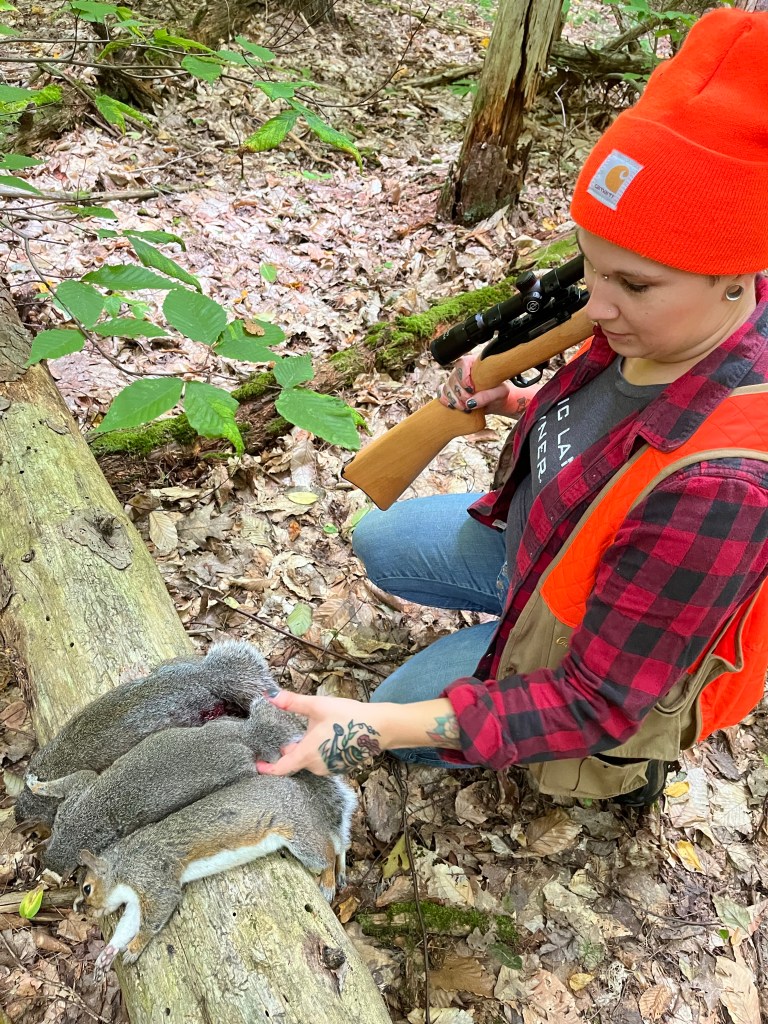
The season that followed shaped me as much as the hunts themselves. A rainy, fruitless deer hunt taught me patience. A canceled turkey mentor class during Covid pushed me into the woods on my own, where I scouted, listened, and learned. That spring, I stumbled into a marsh alive with herons and wood ducks, a scene that felt pulled from Wendell Berry’s The Peace of Wild Things. I saw moose and bear for the first time. In the fall of 2020, I finally harvested squirrels and began to feel like a real hunter.

By 2021, the experience deepened. I helped a friend haul out his first deer, an emotional and exhausting task that underscored the weight of taking an animal’s life. That same fall, Rosie and I made the long drive north to Pittsburg, New Hampshire. Alone, using everything I had learned, I sought out grouse habitat. Every flush startled me, my heart racing with each burst of wings. On the last evening, as the light faded, I finally raised my gun, took the safety off and swung the barrel toward the bird—only to watch it disappear behind trees. Still, the moment confirmed what I already knew: this pursuit had become a part of me.

But Rosie was aging. I sensed my time with her was short, and I also knew that someday I would need a bird dog. Rosie passed away on October 25, 2022, just three days before my second trip to Pittsburg. On that trip, I crossed paths with a hunter and his beagle, Hatchet. When he explained they were rabbit hunting, I broke down in tears. The irony was almost too much to bear: meeting rabbit hunters after losing the dog whose chase of a rabbit had set my life on this path.

Over the next year, I researched dog breeds obsessively. One breed kept resurfacing: the Bracco Italiano. By chance—or fate—my friend attended a pheasant hunt where the guide’s dog was a Bracco. He returned with photos and the breeder’s contact information. After months of emailing breeders across the country, I discovered that this one, Bob, lived nearby. Bob became my mentor and, eventually, one of my close friends.

That spring, I brought home Pipp. Raising her—my first puppy, my first bird dog—was intimidating. Bob guided me through every step, making sure I understood what it meant to train and care for a true hunting companion.

Last season, I brought Rosie’s ashes back with me to the North Country and spread them there in her honor. She may not have been a bird dog, but in her own way she was my first hunting companion. That weekend, Pipp caught scent of something and took off with a drive I knew wasn’t for a bird. Moments later, a snowshoe hare darted across the trail with Pipp close behind. I didn’t have a safe shot, and that didn’t matter. I stood in the trail with tears in my eyes, watching the rabbit run, knowing that Rosie’s spirit was with us again.

I hope to hunt with Rob and Hatchet at some point this year. Since that day in Pittsburg, Rob and I have stayed connected. He now has two Brittanys, and each fall we bird hunt together. Those friendships, like the hunts themselves, feel like another thread in the larger circle of this story.

I look back on that first rabbit, those early classes, the failures and the lessons, and I see the arc of a story I didn’t know I was writing. Hunting has become part of my identity, woven into the fabric of who I am. It is more than a pursuit—it is a spiritual practice, a grounding force, a way of belonging in the world.

Driving home from Hunter Ed this week, I felt the weight of that circle closing, and opening again. Bird hunting—and now fly fishing—bring me a peace that feels deep and lasting. “How lucky am I”, I thought, “to lead such a life!”.

Communion

Tuesday, April 15th was a hard day.

Jerry had been one of our breeding rabbits for the past three years—the last of our original rabbits. He sired many litters and helped put a lot of food on our table. When we first got into raising meat rabbits, I decided we’d only name the breeding ones, knowing they’d be around longer. But I guess I never thought much about the end of their lives. I assumed they’d just grow old and die naturally.

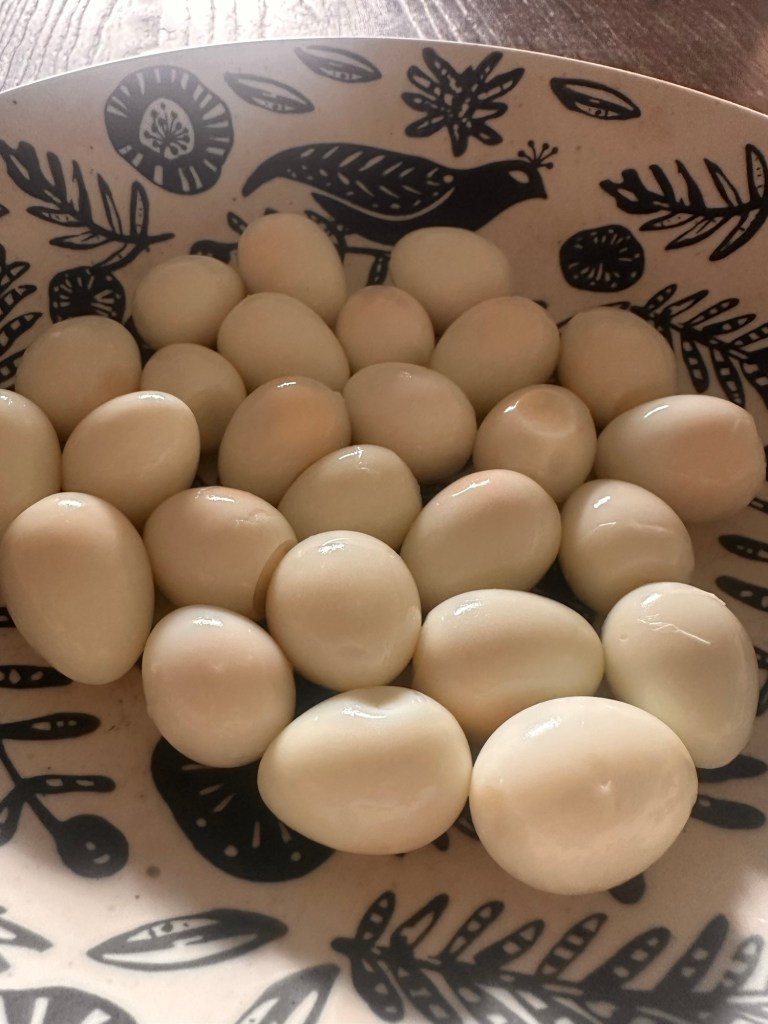
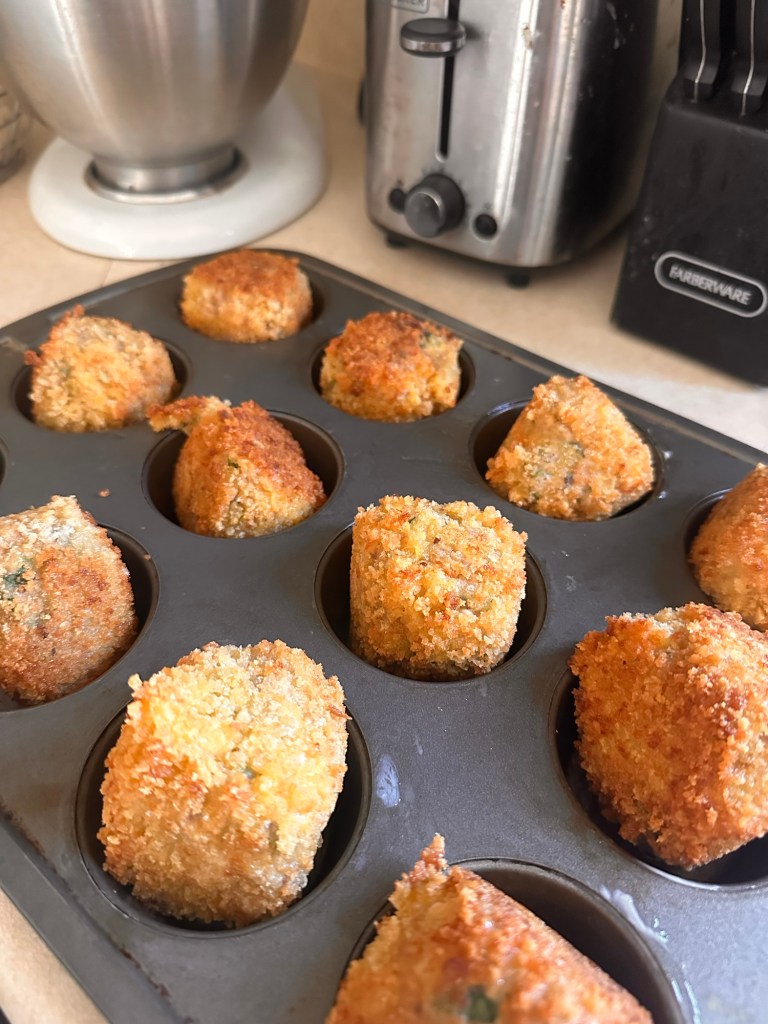
What I hadn’t realized was that Jerry had stopped breeding. And so, not allowing him to feed us one last time felt like a disservice—to us, and to him. It didn’t make it any easier, though, to process his body and turn the meat into something beautiful and nourishing, like the scotch egg recipe we made with his meat and our quail eggs.

Peeled, hard boiled quail eggs.

Food, at its core, is communal. It always has been—across cultures and centuries. Rituals, ceremonies, celebrations—all of them connect us to each other and to the land through food. Being directly involved in sourcing my own meat has made me more aware of my own mortality. It’s made me confront change and impermanence in a way I hadn’t before. Life is precious and fleeting. One minute, Jerry was living his ordinary life—eating, sleeping, pooping—and the next, we were breaking down his body with intention and care.

Even now, three months later, I still feel a deep well of emotion. I’m not sure I can convey it to someone who hasn’t hunted or raised meat animals. Of course it’s sad. Of course it’s hard. And yes, sometimes I feel a flicker of guilt for taking another life. But I think it’s those very feelings that make us human—the ones so many people avoid because they’re uncomfortable. I don’t say this from a place of pride, but with the quiet grief of knowing we’ve lost something essential in our detachment from death. This lifestyle forces me to hold space for deep sorrow and grief, right alongside immense joy and gratitude.

Sharing that meal—scotch eggs made from our own quail eggs and the meat of our longest-living rabbit—was something I’ll never forget. To others, it may have looked like just another meal. But for us, it was a true celebration. Jerry gave his life not only through the rabbits he sired, but through his own body. That meal was a celebration of his life, our life, and the web of love and friendship we share.

Oddly, it reminded me of communion from my religious upbringing. I always thought communion was strange—morbid, even. We weren’t really eating the body and blood of Christ, so what was the point? But this meal gave me a new kind of understanding. Life and death are deeply intertwined, not just in metaphor, but in the tangible, physical world. And in someway, it was fitting during the spring, right before Easter, to enjoy this meal in communion with our best friends.

Scotch eggs, fresh from the oven!

Someday, I’ll die too. I’m aware of that. But it’s easy to forget in the bustle of everyday life. Having a hand in my own food—raising it, harvesting it—roots me in the present. It reminds me that I’m alive right now, and allows me to fully embrace the moment in front of me.

Pride.

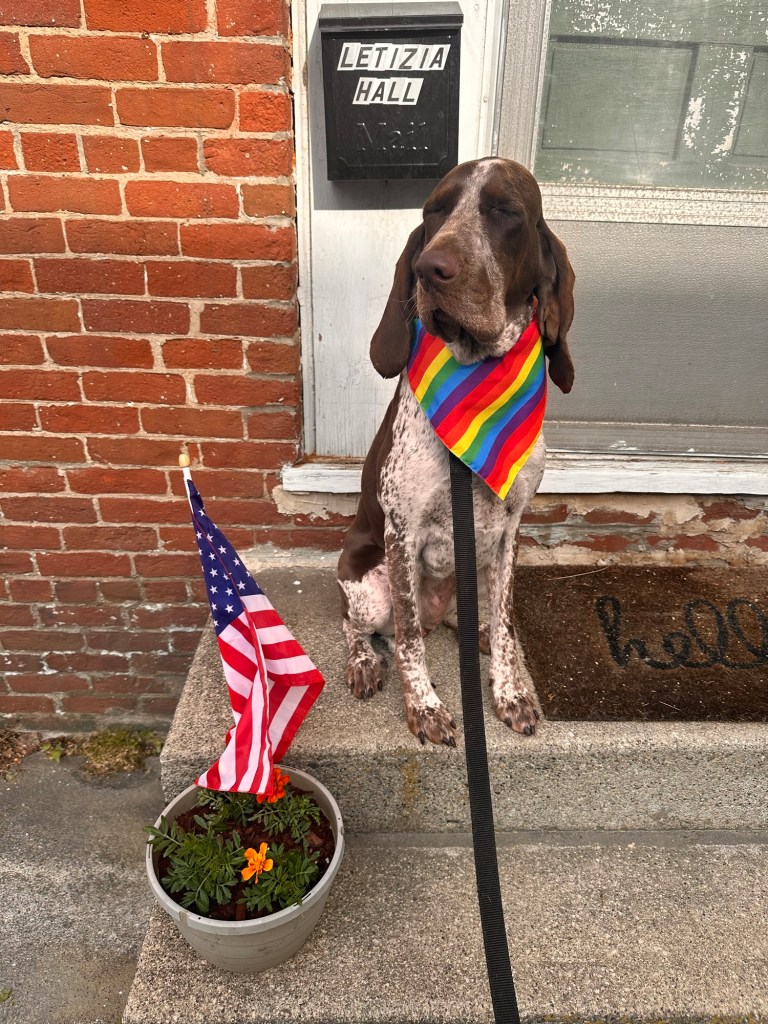
Pipp rocking her Pride bandana!

Today is Sunday, June 1. I’m sharing an old episode of my (now defunct and very short lived) podcast because it was an inspiring conversation with my friend regarding holding space for parts of identity our culture sometimes views as at odds, being queer and being a hunter. I’m not typically one for labels, but both of those parts of my identity feel so deeply connected to who I am as a human. We explored the topic in this discussion.

https://podcasts.apple.com/us/podcast/the-amateur-hunting-enthusiast/id1497772525?i=1000485137585

Below is a link to the article that Josh wrote that I referenced in our conversation.

Quilled

September 28th marked the opening day of the 2024 bird hunting season in Vermont. It was a bright, sunny, and relatively warm day. I had high hopes and was filled with excitement for the first day of Pipp’s second season afield. I felt as if we both now had enough training days together to understand what we were supposed to be doing in the field, and I was eager to see it all come together. Last season, she was just a six-month-old puppy, and I was still a relatively new hunter, a first-time bird dog owner.

We were barely fifty yards into the woods when Pipp got birdy. In hindsight, I’m not sure what I was expecting. At the time, I wasn’t fully trusting her nose. I likely, though subconsciously, anticipated a chipmunk or squirrel. This came from watching her excited body language during our early fall walks in the woods. Grouse aren’t as common in our part of the state, and Woodcock hadn’t arrived as stopovers on their migration path yet. Meanwhile, small, furry critters were abundant.

Suddenly, Pipp slammed on point. It was surreal. The scene I had imagined a hundred times in my mind—her pointing our first wild bird—was unfolding before me. Last year, we had plenty of flushes and bumps that startled us both. But the moment I was experiencing now seemed to make time stand still. What felt like an eternity for observation and thought seemed to happen in the blink of an eye in terms of my physical response. It’s remarkable how the brain can hold space for multiple lines of thought at once.

Just as my mind reminded my hands to get my gun ready, something burst into flight to my right. I heard its signature whistle and instantly knew it was a Woodcock, even though I only saw its movement out of the corner of my eye. Oddly, Pipp remained fixated straight ahead, not toward the right where the bird had taken off. Then, out of the corner of my eye, I saw another one holding tight in front of her. I took a couple of steps, readied my shotgun, and the second Woodcock flew up. I had the perfect straight-away shot at just the right height. I missed.

It didn’t matter that I missed the bird. Pipp might disagree, but I was elated by the experience—just moments into our first hunt of the season. On cloud nine, we pressed on.

Pipp sulking because she wanted to continue to hunt after a run-in with a porcupine.

About an hour later, I heard a Grouse drumming. They do this in the fall, a form of territorial communication. We set off in the direction of the sound.

We were crossing a clearcut, filled with brush and stumps, when I saw Pipp get excited about something. This wasn’t a place I’d expect a grouse—especially in or under a log. Deadfall in the forest, sure, but in the middle of a recently logged area?

Then I saw Pipp nose something and begin frantically circling and pawing at her face. At first, I thought she might have a branch stuck in her nose. But then I realized—it was a face full of porcupine quills. Panic washed over me, followed by the inner monologue: “Goddamn it, not on the first day of the season!” and “Okay, business time—start the hike out immediately and call the emergency vet.”

By the time we reached the end of our trek out, Pipp had calmed down a bit and was trying to hunt the area where the Woodcock had been. Once we reached the Jeep, I could see that it wasn’t the worst-case scenario of hundreds of quills—more like twenty, with only a few in her mouth and none in her eyes. My vet was wonderful, showing me how to use hemostats to remove the quills properly and completely (the “cut the quill” method is a myth, by the way). Using a sedative, the vet removed the quills in about ten minutes, for a total of nearly $700. Of course, my pet insurance deductible is $750.

None of this mattered, though. I was just relieved to have Pipp feeling better, and even more thrilled when the vet said we could go out hunting again later that day. We both rested for the remainder of the afternoon.

It was a tough financial lesson, as this was the money I’d set aside for my Minnesota trip, which would have to be postponed for another year. I was disappointed, having looked forward to the trip for months. But I was also anxious about the potential risks of hunting—what if she got injured more seriously: cut from old barbed wire, a stick in her eye, or any number of worse-case scenarios my brain could concoct. Needless to say, I now set aside money specifically for vet bills in addition to my pet insurance.

The view from our hunt on the morning of opening day in VT.

Overall, it was a day full of adventure and excitement. In hindsight, it makes for a good story. Sometimes the unexpected is welcome, and other times less so. Luckily, Pipp and I both came out of the porcupine experience no worse for the wear, and our first interaction with Woodcock of the season was marvelous. We’ll take the bad with the good.

Growth

In nature, growth can be as slow as a snail moving across a leaf or as rapid as water rushing into a canyon during a flash flood after a thunderstorm. I often think about tree rings—small, incremental growth happening consistently over time. It’s the kind of growth that goes unnoticed each year, but after decades, it becomes awe-inspiring.

The stump of a felled tree found while leading a kid’s “Nature Explorers” class at a summer camp.

This is one of my favorite pictures: the stump of a felled tree I found while leading a “Nature Explorers” class at a summer camp. The tree had faced some sort of disease or wound that it managed to ward off for a time, but eventually, it succumbed. The crosscut is beautifully imperfect, with the two edges curled into one another.

Yet, the tree kept growing.

My journey with Pipp has mirrored that slow, steady growth, both for the dog and for me as her handler. I have a picture of her as a two-day-old puppy, visited her at six weeks old, and brought her home at 10 weeks. We started our first bird dog training the very next weekend when she was 11 weeks old.

Pipp and her littermates at their first training.

At that training, I had my first lesson in learning to trust her—and in appreciating the trust she places in me. Prior to Pipp, I had two rescue dogs, and they taught me a lot about training and canine behavior, especially since much of my time with them was spent managing habits that had already been formed. This was the first time I was working with a young puppy, and I was both terrified of messing it up and excited by the potential. It felt like the world was our oyster.

I’d read books, listened to podcasts, and sought out information on gundog training for months before bringing Pipp home. The sheer volume of information was overwhelming, but the wisdom of Pipp’s breeder resonated deeply with me and helped put everything else into perspective: 

Enjoy your dog. Have fun with her. Your bond will allow you to accomplish great things together.

The first time in the field, she was supposed to find and point a tethered quail, but she veered way off track from where the orange paracord was tied to a cluster of cover. For a moment, I questioned what was happening, until the trainer pointed out that the quail had slipped its tether and Pipp was actually pointing it where it had wandered off to.

Twice this year, we’ve found ourselves in a similar situation—my inner monologue questioning her nose (both times, pointing at a tree only to flush a chukar and later an entire covey of grouse). But Pipp followed her instinct, and sure enough, she was right. Watching her gain that confidence made me realize just how important it is for us to trust each other. I’d never had an off-leash dog before, and that bond is foundational for her role as my hunting companion.

The moment when Pipp found the untethered wandering quail.

“Most importantly, she continues to teach me that our bond will be the foundation for all of our training, learning, and growth.”

“I’m a better person for having found this breed and for loving this wonderful girl. I’m excited to watch our growth and progress over time, knowing there will be challenges, failures, and successes. Each of these experiences will teach us something. But the most important lesson of all is to enjoy our time together. Life is brief, and even more so for our four-legged companions. The next day is never guaranteed, and my greatest goal is to remember this every day, cherishing our time both at home and afield.”

Hunting as a Spiritual Practice

While I am not religious, I feel a deep spiritual connection with nature, especially when hunting. It reminds me of my place within the natural order—that I am a part of nature, not separate from it. Long ago, I decided that if I were to consume animal protein, I needed to take an active role in procuring my own nourishment. This choice has been particularly challenging as someone who loves animals. Raising and hunting them for food continually pushes me to be mindful of my methods and to constantly evaluate the ethics at the heart of these practices.

For me, these ethics are rooted in love—love for the wildlife, the landscape, the hunt as an experience, the deep emotions it stirs, and, in many ways, a hard-earned love for myself through it all. Adding to this complexity is my hunting partner and loyal four-legged companion, Pipp. My love for her surpasses what I feel for most people, making the idea of trapping or hunting coyotes and foxes an especially difficult reality to face. So why do it, you ask?

My favorite place to be with my favorite four-legged friend!

I was a vegetarian for four years. But if you ask any of my friends, they’ll tell you—I was a pretty terrible one. I’d try my best to avoid meat, only to inevitably cave. My body craves red meat and other animal proteins, and my hormones went haywire on soy products and plant-based alternatives.

In college, I studied sustainable food and agriculture, and if there’s one thing I know for certain, it’s that even the food consumed by vegans and vegetarians is produced through methods that inadvertently kill animals—not to mention the environmental destruction and human exploitation that come with industrialized farming. It’s neither sustainable nor truly ethical.

I wanted to source my meat in a way that felt holistic and natural, but I never believed I could take an animal’s life to do so. Ironically, it was an animal—an American Bulldog named Rosie—who changed my mind. But that’s a story so meaningful, it deserves a post of its own.

More to come about Rosie, my first “hunting dog” who killed the rabbit that sparked my journey into hunting.

As I embarked on my journey to becoming a hunter—an identity that is deeply woven into my way of life—I felt both exhilaration at the prospect of learning and fear at the reality of beginning.